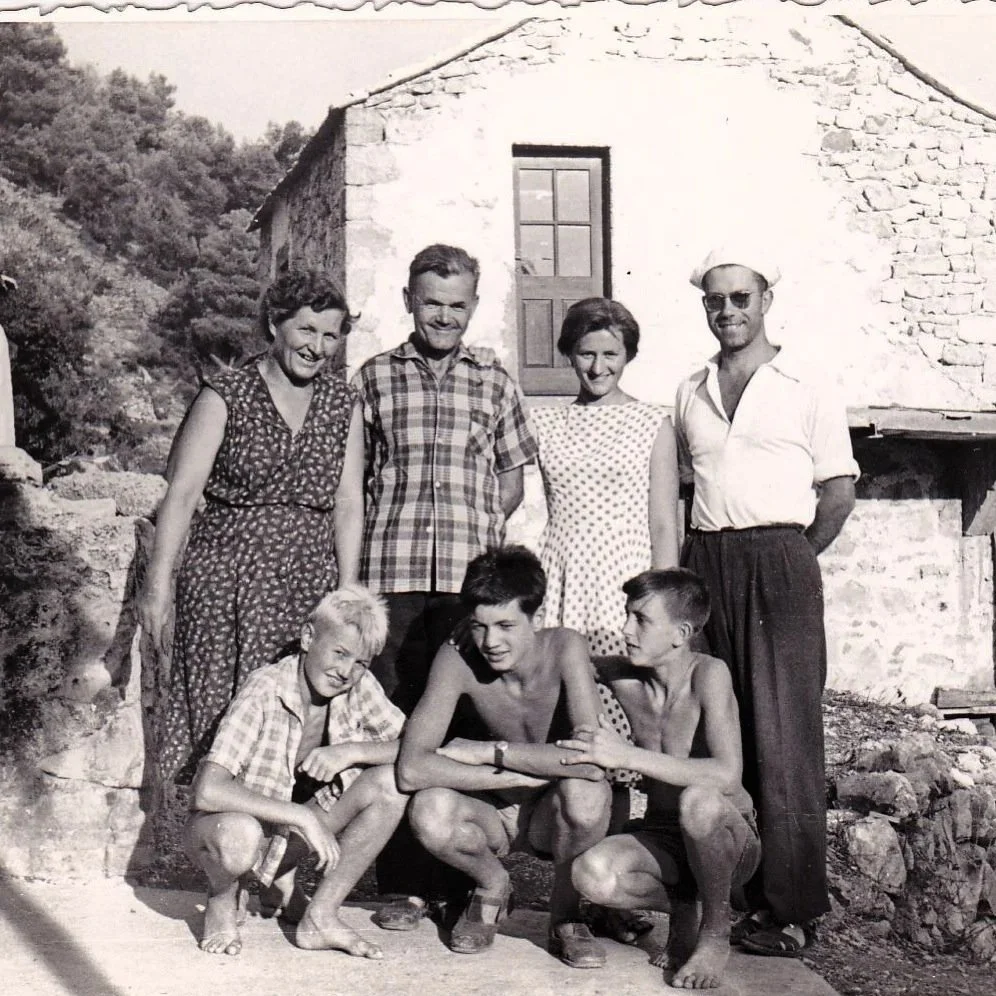
Gdinj, Hvar 1958 | top: Baka Matija (grandmother) Deda Ivo (grandfather), Vera (aunt), Don Vicko bottom: Marin (uncle), Kruno (Marko’s father), Kristo (friend)
One of the crown jewels of the Dalmatian coast, the island of Hvar has a history stretching from the Ancient Greeks and Romans to the Venetians—and to the Rojnica family. Kruno (Marko’s father) and Dr. Marin Rojnica (Marko’s uncle who still lives on Hvar) spent their childhood summers as alter boys in the village of Gdinj in the 1950s. They fell in love with its lavender, fig, and olive groves, its seafaring traditions, and the soulful a cappella klapa singing. In the early 1970s, they bought land in a small bay called Lučica and built a family home by hand. From that moment on, Hvar became the family’s constant: every summer, every generation. It was also August when Marko first arrived as a two-month-old.
Away from the bustle of Hvar town, villages like Jelsa and Pitve reflect the island’s quiet elegance and deep history—much of it most recently shaped in the late 19th century under Austrian Emperor Franz Joseph I. Drawn by the island’s natural splendor and practical necessity, the Empire developed the port of Jelsa to export local wines at a time when phylloxera had devastated French vineyards, suddenly making Hvar’s Plavac Mali and Bogdanuša essential to Europe’s wine trade.
Marko and his cousins spent countless summers roaming these streets, beaches, and vineyards—long before he knew it, Hvar defined paradise for him.
Last August, on a ride in the tiny family rowboat, Kata asked Marko, “What’s the craziest thing you’ve ever done on this little boat?” Marko answered by asking her to marry him.